
Prior to 1 July 2022, to calculate a deduction for expenses incurred as a result of working from home, taxpayers have the choice of using one of the following methods:
The Shortcut Method – allowed 80c per hour for each hour a taxpayer worked from home to calculate all their additional running expenses, such as electricity, gas, internet, mobile and home telephone expenses, all depreciation, stationery, computer consumables etc.
The Fixed Rate Method – allowed 52c per hour for each hour a taxpayer worked from home to calculate their electricity and gas expenses, office cleaning and depreciation of furniture and furnishings. In addition, a separate deduction for work related internet, mobile and home telephone, stationery and computer consumables and depreciation of computers, laptops and similar devices could be claimed.
Actual Expenses – that is, calculating the actual expenses incurred as a result of working from home.
From 1 July 2022, taxpayers can continue to claim their actual expenses or, alternatively, they can use the revised fixed rate method of 67c per hour for each hour they work from home. The rate per hour calculates the total of your deductible expenses for energy, internet, mobile and/or home telephone and stationery and computer consumables for the income year. This means you cannot claim an additional separate deduction for any of these expenses. For example, if you use your mobile when working from home and when you work from somewhere other than your home, your total deduction for the mobile phone expenses will be covered by the hourly rate of 67c per hour. However, the actual decline in value deduction for the depreciating assets used while working from home can be claimed separately, providing the requirements of Section 8-1 and Divisions 40 and 900 or Section 262A of the ITAA 1936 are satisfied.
We have provided an example below adapted from the draft Practical Compliance Guideline (PCG) 2022/D4 to outline this.
The criteria for using the revised Fixed Rate Method consists of three parts:
- You must actually be working from home on or after 1 July 2022. Minimal tasks such as occasionally checking emails or taking telephone calls while at home will not qualify.
- You must incur the additional running expenses which are deductible under section 8-1 as a result of working from home. In circumstances where a third party (for example, an employer) reimburses you for your additional running expenses or is incurring the additional running expenses on your behalf, will not satisfy this criteria.
- You must keep and retain relevant records in respect of the time you spend working from home and for the additional running expenses, such as invoices or bills in the name of the home owner. Where invoices or bills are in the name of one member of the household but the cost is shared, each member of the household who contributes to the payment of that expense will be taken to have incurred it. You must have records that show the total number of hours you worked from home during the income year and at least one invoice, bill or credit card statement for each of the additional running expenses you have incurred during the income year.
For the 2022-2023 income year, you need to keep:
- A record which is representative of the total number of hours worked from home during the period 1 July 2022 to 28 February 2023, and
- A detailed record of the total number of hours you worked from home for the period 1 March 2023 to 30 June 2023
- For energy, mobile and/or home telephone and internet expenses, you must keep one monthly or quarterly bill.
- For stationery and computer consumables you must keep the receipt for the item purchased.
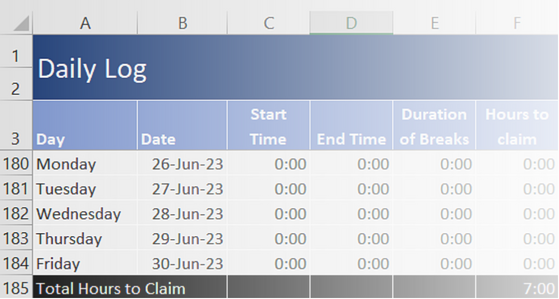
For the 2023-24 and later income years, you must keep detailed records for the entire income year of the number of hours you worked from home during that income year. An estimate will not be accepted. A record of your hours for the income year can be in the form of: timesheets, rosters and a diary/log or similar document.
To assist keeping detailed records of hours working from home we have created a simple log for the period 1 March 2023 to 30 June 2023 which can be accessed here:
1 March to
Example as adapted from draft PCG 2022/D4
Piruntha is employed as software engineer. In November 2022, Piruntha’s employer decides to give their employees some flexibility by allowing them to work from home. However, each employee must work from the office at least 3 days per week. Piruntha decides to take advantage of this arrangement and work at the office 3 days per week and from home 2 days per week. To work from home, Piruntha sets up a room in her home as an office.
On 1 December 2022, Piruntha purchases a laptop for $1,499, a desk for $250 and an office chair for $299. She also purchases some stationery to use while she is working from home. On 6 December 2022, Piruntha commences working from home. When working from home, she uses the lights in her home office, as well as her laptop, her personal internet connection and her personal mobile phone (which she also uses when she is working at her employer’s office and for private purposes).
Up until the end of February 2023, Piruntha uses her air conditioning to cool her home office and from around April 2023 until 30 June 2023, she uses her gas heating to warm the room.
Piruntha keeps a record of the time she spends working from home during the 2022–23 income year, which shows she worked a total of 560 hours at home. For a representative 4-week period, Piruntha keeps records which show that she uses her laptop, desk and office chair for around 5 hours per week while she is gaming and internet shopping and around 20 hours per week for work purposes.
Piruntha also keeps one quarterly invoice for her electricity and gas expenses, one monthly internet bill and one monthly mobile phone bill for the period 6 December 2022 to 30 June 2023. She also keeps the receipt for the stationery she purchased on 1 December 2022.
At the end of the 2022–23 income year, Piruntha determines that she meets all the criteria set out in paragraph 18 of PCG 2022/D4 because she:
- Is working from home to carry out her employment duties
- Has incurred additional running expenses as a result of working from home, and
- Has retained the relevant records.
As such, she decides to calculate her additional running expenses using the revised fixed-rate method.
First, Piruntha multiplies the total number of hours she worked from home by the hourly rate. Her calculation is:
560 hours × 67c per hour = $375.20.
This is Piruntha's deduction for her electricity, gas, mobile phone, internet and stationery expenses.
As the desk and office chair Piruntha purchased cost less than $300, she can claim the full purchase price of them in the 2022-23 income year. However, she must reduce her deduction for her private use of those items.[35] Piruntha works out her private and work-related use of her depreciating assets as follows:
Time spent using assets for work = 20 hours per week
Time spent using the assets for private purposes = 5 hours per week
Total hours assets used per week = 25 hours
5 hours per week ÷ 25 hours per week = 20% private use
20 hours per week ÷ 25 hours per week = 80% work-related use.
The decline in value deduction (related to her work-related use) for the desk and chair is:
$250 × 80% = $200
$299 × 80% = $239.20
To calculate the decline in value of her laptop, Piruntha uses the depreciation and capital allowances tool on the ATO's website and chooses to use the diminishing value method. The tool calculates the decline in value of the laptop as:
|
Income year
|
Opening adjustable value
|
Decline in value (using diminishing value method)
|
Taxable use
|
Deductible decline in value
|
Adjustable value at end of year
|
|
2022-23
|
$1,499
|
$870.65
|
80%
|
$696.52
|
$628.35
|
To work out the total amount of her deduction for the additional running expenses she incurred as a result of working from home during the 2022-23 income year, Piruntha adds the amount calculated using the hourly rate to the work-related decline in value of her laptop, desk and chair. This is calculated as:
$375.20 + $200 + $239.20 + $696.52 = $1,510.
When she lodges her 2022-23 tax return, Piruntha includes a deduction of $1,510 for her working from home expenses at the other work-related expenses question.
Even though Piruntha also uses her personal mobile phone for work when she is in the office, she cannot claim any additional deduction for this work-related use of her phone in her 2022-23 income tax return.
Download the full Client Newsletter February 2023